Digital transformation is one of the most used phrases in business, and one of the least understood. Some vendors use it to mean a new website. Others use it to mean replacing every system a company owns. Neither is quite right.
This guide explains what digital transformation means according to the analysts and researchers who study it, how it differs from simply going paperless, why so many programmes fall short, and what a realistic transformation looks like for an established business in the UAE.
What is digital transformation?
Digital transformation is the change in how an organization works, serves its customers and makes decisions, made possible by digital technology. The technology is the means. The goal is a better-run business.
Leading research bodies define it in similar terms:
- Gartner describes digital transformation as the process of exploiting digital technologies and supporting capabilities to create a robust new digital business model.
- George Westerman of the MIT Sloan School of Management, co-author of Leading Digital, defines it as using technology to radically improve the performance or reach of an organization. He stresses that the focus should be on making the company better, not on the technology itself.
Both definitions say the same thing: buying software is not transformation. Transformation happens when the way people work changes because of it.
Digitization, digitalization and digital transformation
Gartner separates three terms that are often used interchangeably. The difference matters, because each one is a step on the way to the next.
| Term | What it means | Example |
|---|---|---|
| Digitization | Converting information from analogue to digital form | Scanning paper delivery notes into PDFs, or typing a ledger into Excel |
| Digitalization | Using digital technology to change a process | Customers book a rental vehicle online instead of by phone |
| Digital transformation | Changing how the whole organization operates, across departments, around connected data | Every branch, warehouse and department works from one central database, and managers see live operations |
Many companies stop at digitization. Their records are digital, but they are still spread across hundreds of Excel files, inboxes and shared folders. The work is still manual, and nobody can see the whole picture.
Why digital transformation matters
The global numbers show how central it has become. IDC forecasts that worldwide spending on digital transformation will reach almost 4 trillion US dollars in 2027, growing at about 16% a year, with AI and generative AI the fastest-growing part.
In the UAE, it is national policy. The UAE Cabinet set up the UAE Council for Digital Economy to double the digital economy’s contribution to GDP by 2031, and the UAE National Strategy for Artificial Intelligence 2031 aims to bring AI into government and every major sector. Government services, banks and large customers increasingly expect their suppliers to work digitally too.
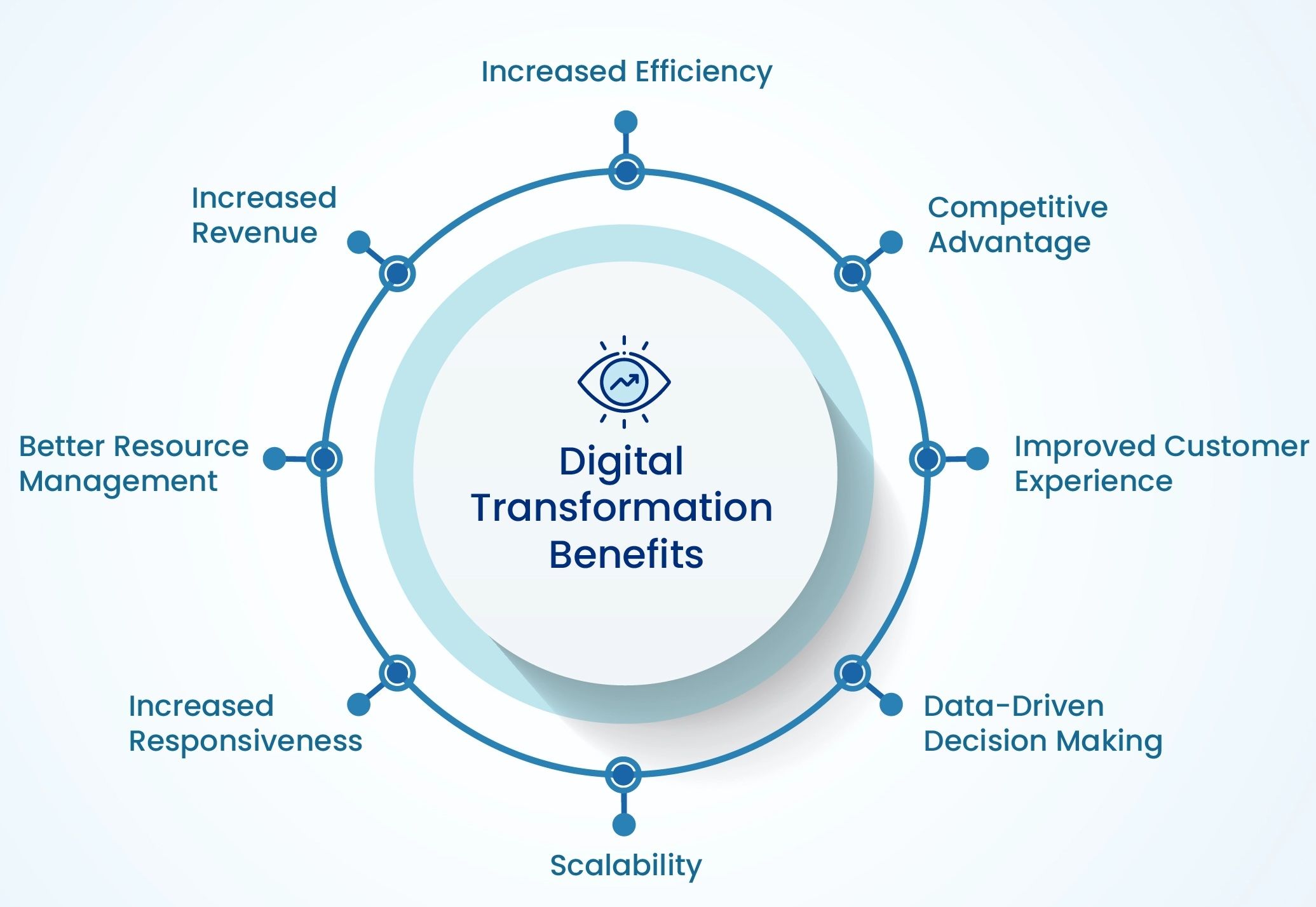
For an individual business, the benefits are practical:
- Efficiency: repetitive work such as reconciliations, data entry and reporting runs automatically.
- Better decisions: managers see live figures instead of waiting for month-end spreadsheets.
- Better customer experience: customers can book, order, pay and track online.
- Scalability: new branches, products and staff are added without adding paperwork.
- Responsiveness: the business can react to demand, delays and problems as they happen.
- Readiness for AI: AI needs clean, connected data. Without it, AI projects have nothing to work with.
Why most digital transformations fall short
Research consistently shows that transformation is hard.
- BCG found that 70% of digital transformations fall short of their objectives (Flipping the Odds of Digital Transformation Success, 2020). Only 30% fully met their goals.
- McKinsey’s global survey (Unlocking success in digital transformations, 2018) found that fewer than one in five organizations had improved performance and sustained it. In traditional industries such as oil and gas, automotive and infrastructure, the success rate was between 4% and 11%.
The reasons are rarely technical. Programmes fail when they try to change everything at once, when leaders lose interest after launch, when the people who do the work are not involved, and when progress is not measured.
Six factors that make transformations succeed
BCG’s research found that organizations which get six things right raise their chance of success from 30% to 80%:
- An integrated strategy with clear goals. Every initiative is tied to a measurable business result, such as “process monthly fines in one day instead of two weeks”.
- Leadership commitment from the CEO to middle management. Transformation is led by the business, not delegated to IT.
- Your best people on the programme. The staff who know the processes best help design the new ones.
- An agile governance mindset. Work is delivered in small phases, reviewed often and adjusted as you learn.
- Effective monitoring of progress. Clear metrics show whether each phase is delivering.
- A business-led, modular technology and data platform. Systems are connected through one data foundation, so each new module adds to the whole instead of becoming another silo.
What digital transformation looks like in practice
For an established company, a sensible transformation is a series of focused steps, not one large project. A typical sequence:
- Discover. Analyze how the business really works today: which data lives where, which tasks take the most time, and where errors happen.
- Plan. Agree a phased roadmap, starting with the processes where digitization saves the most time or money.
- Build and connect. Digitize one department at a time and connect each new system to one central database.
- Adopt. Train each team and agree every change with the people it affects before it goes live.
- Improve with AI. Once data is connected, add automation and AI to process documents, spot problems and forecast demand.
A UAE example: Refrigerated Transport Systems
Refrigerated Transport Systems (RTS) has built refrigerated truck bodies in the UAE for 40 years and runs a refrigerated vehicle rental business. Its records lived in documents and Excel sheets spread across several branches.
Over more than two years, working department by department, we moved every user onto one company email domain, brought HR and factory attendance into one system, merged all branches and businesses into one central database, and launched a rental booking system. Monthly Salik toll and traffic fine processing, which took two weeks of manual matching, now takes one day: the team uploads the raw data and each charge is assigned to the right customer automatically. Inventory across warehouses is centralized, and production across the box-building, painting, electrical and automotive workshops is being brought into one line where every order’s stage is visible.
Read the full RTS digital transformation case study. For a closer look at manufacturing, see Digital transformation for fabrication companies.
Where AI fits
AI is now part of almost every transformation conversation. It works best after your data is digital and connected, not before. Once it is, AI can read invoices and statements and turn them into structured records, answer questions about orders or stock in plain language, flag unusual charges or delays, and support forecasting from your own history.
Companies that start with AI and skip the data foundation usually find their models have nothing reliable to learn from.
How to get started
You don’t need a five-year master plan to begin. Start by answering three questions:
- Which task takes your team the most time every month?
- Which data is typed in more than once, in more than one place?
- What would managers decide differently if they could see live figures?
The answers usually point to the first phase. Fix that, measure the result, and move to the next department.
Shubbak Technologies helps manufacturers, trading companies, oil and gas firms, sports organizations and startups in the UAE plan and deliver this kind of change, from consulting and roadmaps to building the systems and supporting them. As partners of Microsoft, Amazon Web Services and Zoho, we choose the right platform for each need rather than forcing everything into one. Learn more about our AI-enabled digital transformation services, or book a free consultation.
References
- Gartner, Information Technology Glossary: definitions of digitization, digitalization and digital transformation.
- George Westerman, Didier Bonnet and Andrew McAfee, Leading Digital: Turning Technology into Business Transformation (Harvard Business Review Press, 2014).
- BCG, Flipping the Odds of Digital Transformation Success (October 2020).
- McKinsey & Company, Unlocking success in digital transformations (October 2018).
- IDC, Worldwide Digital Transformation Spending Guide (May 2024).
- WAM, UAE’s national digital economy set to grow to $140 billion by 2031.